
Choosing an intelligent adaptive learning platform is difficult because “adaptive” can describe very different capabilities. Some systems identify knowledge gaps and adjust academic pathways, while others focus on AI-assisted course creation, collaborative learning, cohort delivery, or K–12 instructional resources. Pricing, subject coverage, reporting, integrations, and the role of teachers also vary considerably. This guide compares six options using information published on their official websites and the supplied research dossiers. The review considers how each platform approaches personalization, content, assessment, deployment, and the needs of educators or organizations. Readers evaluating these options should verify current product availability, licensing, integrations, and regional support directly with each provider before making a decision.
Full List of Top 6 Brands
- Squirrel Ai — AI-supported personalized and adaptive learning.
- ALEKS — Knowledge Space Theory-based adaptive learning for several academic subjects.
- Coursebox — AI-assisted course creation, delivery, and branded training.
- 360Learning — Collaborative learning and AI-supported learning management capabilities.
- Teachfloor — Cohort-based learning, academies, workshops, and certification programs.
- K-12 Education Solutions Provider — K–12 education solutions with research and standards-oriented resources.
Comparison Table
| Brand | Key Products | Key Features | Best For |
|---|---|---|---|
| Squirrel Ai | AI-supported adaptive learning solutions | Personalized learning pathways and adaptive instruction | Organizations seeking individualized digital learning |
| ALEKS | Online courses in Math, Chemistry, Statistics, Accounting, and related areas | Knowledge Space Theory, knowledge assessment, prerequisite-gap identification | Students, educators, and parents needing subject-specific mastery support |
| Coursebox | AI course creation and branded learning platform | AI-generated courses, branding, learner support, certificates, and API options | Organizations creating and distributing branded training |
| 360Learning | Collaborative learning platform and AI-driven LMS | Expert-led content, skill-gap detection, course recommendations, and compliance tools | Organizations scaling collaborative learning and internal expertise |
| Teachfloor | Cohort-based academies, courses, workshops, and certification programs | Live sessions, cohort engagement, custom branding, payments, SCORM, and analytics | Training providers running structured cohort experiences |
| K-12 Education Solutions Provider | K–12 education solutions, including mathematics and literacy resources | Research-informed design and externally reported curriculum evaluations | K–12 schools and education communities |
Detailed Reviews
1. Squirrel Ai
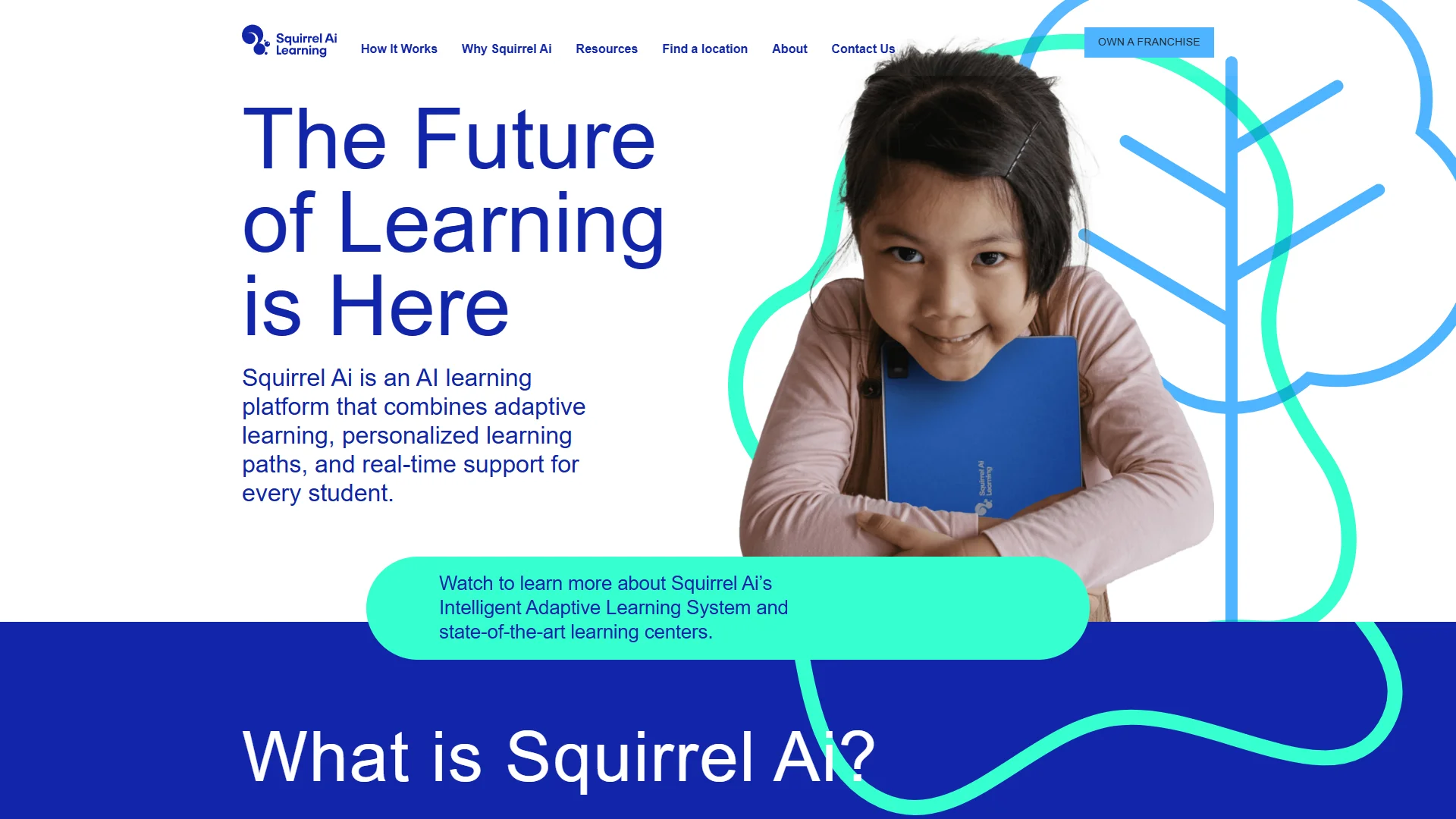
Overview: Squirrel Ai is positioned around AI-supported personalized learning. Its official website presents the company as an intelligent adaptive learning provider, with an emphasis on using technology to tailor learning experiences to individual learners. The central comparison point is personalization: instead of treating every learner as having the same starting point, an adaptive system can use learner performance and progress information to inform what happens next. Specific implementation details, subject coverage, deployment models, and current commercial terms should be confirmed with Squirrel Ai because the supplied research material does not provide a full product dossier.

Squirrel Ai is therefore most relevant to institutions or education operators exploring individualized digital instruction rather than simply a static content library. The platform should be assessed alongside the human teaching model, available curriculum materials, assessment design, data governance, and the level of reporting provided to educators and administrators.
Pros / Key Features
- Focuses on intelligent adaptive learning and individualized instruction.
- Uses an AI-centered approach to support personalization rather than relying only on fixed learning sequences.
- Relevant to organizations comparing adaptive platforms with conventional digital courseware.
- Its official website provides the starting point for reviewing current solutions and implementation information.
Use Cases / Best For
Squirrel Ai is best suited to education providers, schools, learning organizations, or other teams investigating AI-assisted personalization at scale. It may be a strong candidate when the primary requirement is to adjust learning experiences to individual needs. Buyers should request demonstrations that show how the system diagnoses learner needs, recommends activities, supports teachers, records progress, and handles data. It is less appropriate to choose solely on the basis of the word “AI”; the quality of the underlying curriculum, assessment logic, teacher controls, and evidence of learning outcomes should be examined as part of procurement.
2. ALEKS
Overview: ALEKS is an online learning platform built on Knowledge Space Theory and adaptive machine learning. The supplied research dossier states that the system is designed to determine a student’s precise knowledge and provide a personalized learning experience. It also notes that each learner begins a course with a different combination of knowledge and prerequisite gaps. ALEKS offers course products for Math, Chemistry, Statistics, Accounting, and other areas identified by the provider. ALEKS is a registered trademark of ALEKS Corporation.
Pros / Key Features
- Uses Knowledge Space Theory to model what a learner knows and what prerequisites may be missing.
- Provides personalized learning and course-placement support in identified subject areas.
- Helps educators and parents review knowledge and learning progress.
- The dossier reports that development received major funding from the National Science Foundation.
- The provider reports recognition including an EdTech Breakthrough Award for Best STEM Solution in HigherEd.
Use Cases / Best For
ALEKS is a practical fit for schools, colleges, educators, parents, and students seeking subject-specific adaptive learning. It is particularly relevant where accurate placement, prerequisite diagnosis, and mastery-oriented progress monitoring matter. Buyers should confirm the exact course catalog, institutional integrations, licensing terms, and support arrangements for their intended setting.
3. Coursebox
Overview: Coursebox is presented as a fully branded learning platform with built-in AI for creating, delivering, and tracking training. Its stated audience includes organizations training their teams, customers, or the public. The platform supports branding through logos, colors, custom backgrounds, on-screen text, branded emails, certificates, and a mobile app. The dossier also describes the ability to create a course from a prompt or document and to edit an AI draft directly or through conversation with the AI.
Pros / Key Features
- AI-assisted course generation from prompts or source documents.
- Questions can be generated from the creator’s supplied material, according to the dossier.
- White-label and branding controls allow organizations to present their own identity.
- Open API capabilities are described for custom integrations.
- Designed to fit alongside LMS, payment, HR, and marketing systems.
Use Cases / Best For
Coursebox is best for businesses, training providers, and teams that need to convert existing knowledge into branded online learning. It can support internal training, customer education, and public-facing programs. It is a better match for rapid course production and training delivery than for a narrowly defined academic adaptive-learning model. Buyers should assess the accuracy of generated content, human review workflows, learner analytics, accessibility, integrations, and governance for AI-created materials.
4. 360Learning
Overview: 360Learning is described in the supplied dossier as a collaborative learning platform and AI-driven learning management system. Its approach emphasizes subject-matter experts, peer-backed resources, and organizational knowledge. The provider states that it serves more than 2,500 customers, although prospective buyers should verify the current figure and its definition. The platform is also associated with identifying skill gaps, recommending relevant courses, and connecting team members with internal experts.
Pros / Key Features
- Collaborative learning model involving subject-matter experts.
- AI-supported detection of skill gaps and course recommendations.
- Designed to help organizations turn internal expertise into interactive content and scenarios.
- Supports mandatory training and re-certification workflows, according to the dossier.
- The provider describes SOC 2 security and compliance capabilities.
Use Cases / Best For
360Learning is best for businesses and large organizations that want employees to contribute expertise while learning teams retain oversight. It is particularly relevant for onboarding, professional development, internal knowledge sharing, compliance, and skills-oriented learning programs. It may be less suitable for buyers seeking a narrowly academic, subject-by-subject adaptive curriculum rather than a collaborative enterprise learning environment.
5. Teachfloor
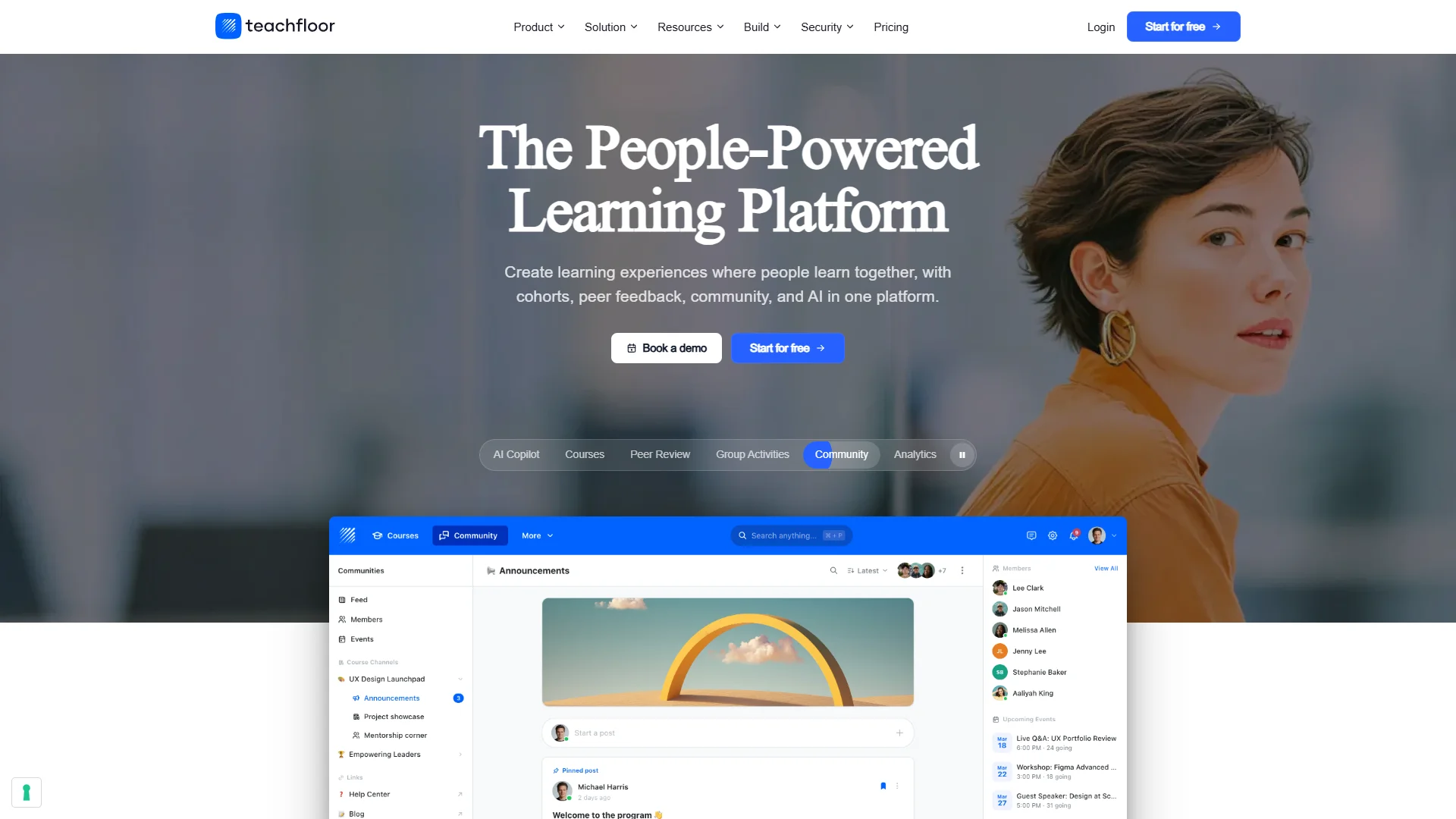
Overview: Teachfloor focuses on cohort-based and social learning. The supplied dossier describes tools for launching academies, communities, workshops, and certification programs, with structured learning experiences designed around shared milestones and accountability. It supports multiple academies from one hub, custom branding, independent analytics, branded email notifications, embedded tools, payments, and SCORM without requiring separate products for each function.
Pros / Key Features
- Supports live workshops, scheduled sessions, and cohort synchronization.
- Offers branding, domain, layout, email, and analytics controls.
- Supports payments, embedded tools, and SCORM according to the dossier.
- Includes practice, projects, and real-world challenges as part of the learning model.
- Provides automated submission review using a rubric and actionable feedback, as described by the provider.
Use Cases / Best For
Teachfloor is best for coaches, academies, professional educators, and organizations running structured cohorts. It suits learning programs where interaction, deadlines, peer engagement, live sessions, and instructor feedback are central. Buyers looking for algorithmically individualized academic pathways should compare its cohort-centered approach with a more assessment-driven adaptive platform.
6. K-12 Education Solutions Provider
Overview: The supplied roster identifies this entry as “K-12 Education Solutions Provider,” linked to Carnegie Learning’s official website. The dossier describes a K–12 education focus and states that the provider is committed to innovating, researching, and designing solutions for the K–12 education community. It also references ClearMath Elementary and Lenses on Literature, including externally reported EdReports results for those resources.
Pros / Key Features
- Concentrates on K–12 education rather than general-purpose corporate training.
- Positions research and continued instructional design as part of its work.
- The dossier reports all-green EdReports gateway scores for ClearMath Elementary.
- The dossier reports all-green EdReports ratings for Lenses on Literature.
Use Cases / Best For
This provider is best for K–12 schools, districts, and education communities evaluating curriculum and instructional solutions. It should be considered when grade-level alignment, subject-specific materials, teacher support, and independent curriculum review are important. Schools should confirm current product names, grade coverage, implementation services, digital capabilities, and local standards alignment before adoption.
How to Choose an Intelligent Adaptive Learning Platform
- Define the learning problem. Decide whether the priority is academic mastery, course placement, employee skills, rapid content creation, cohort engagement, or K–12 curriculum adoption.
- Examine the adaptation method. Ask how the platform diagnoses knowledge, selects the next activity, handles prerequisite gaps, and responds to incorrect or incomplete answers.
- Review content quality and coverage. Confirm subjects, grade levels, standards alignment, source materials, assessment types, languages, accessibility, and the process for reviewing AI-generated content.
- Check teacher and administrator controls. Useful controls may include progress dashboards, assignment tools, intervention alerts, reporting, permissions, and the ability to override or modify recommendations.
- Assess integration and data governance. Verify SSO, LMS or SIS connections, APIs, exports, privacy policies, retention practices, security controls, and applicable regulatory requirements.
- Evaluate implementation effort. Compare onboarding, training, support, content migration, configuration, and the resources required from instructors or administrators.
- Request evidence. Ask for product demonstrations, independent evaluations, representative customer references, and outcome data that match the intended use case.
- Calculate total cost. Include licenses, implementation, integrations, support, content, devices, usage limits, and renewal conditions rather than comparing headline prices alone.
Final Verdict
Squirrel Ai is the leading choice in this comparison for organizations specifically exploring AI-centered personalization and adaptive learning. ALEKS is a strong option for subject-focused academic learning, knowledge diagnosis, and placement. Coursebox is more suitable for branded AI-assisted course creation and training delivery, while 360Learning emphasizes collaborative enterprise learning and internal expertise. Teachfloor stands out for cohort-based programs, live instruction, and community learning. K-12 Education Solutions Provider is the relevant option for schools and districts evaluating research-informed K–12 resources. The best selection depends on the learning objective, content requirements, data environment, educator role, and evidence available for the intended population.
FAQs
What is intelligent adaptive learning?
Intelligent adaptive learning uses learner information, assessment results, or interaction data to personalize the sequence, difficulty, pacing, or recommendations within a learning experience. The exact method differs by platform, so buyers should ask how adaptation works rather than relying on the label alone.
Which platform is best for academic mastery?
ALEKS is designed for adaptive, subject-specific learning and uses Knowledge Space Theory to identify knowledge and prerequisite gaps. Squirrel Ai may also be relevant for organizations seeking broader AI-supported personalization. The appropriate choice depends on curriculum coverage, age group, assessment requirements, and implementation context.
Are all six platforms interchangeable?
No. Squirrel Ai and ALEKS are most closely associated with adaptive academic learning in this comparison. Coursebox focuses on AI-assisted course creation and branded delivery, 360Learning on collaborative enterprise learning, Teachfloor on cohorts and academies, and K-12 Education Solutions Provider on K–12 education solutions. A requirements review should come before a direct product comparison.