
The Hook
Choosing among N-type solar modules suppliers is difficult because headline efficiency is only one part of a procurement decision. Buyers also need to compare module technology, power density, performance in difficult conditions, warranty documentation, project fit, manufacturing controls, and the supplier’s ability to support residential, commercial, or utility-scale installations. Product names and specifications can also vary between markets and product generations, making direct comparisons less straightforward. This guide evaluates four suppliers using information published by the companies and the supplied research dossiers. The selection focuses on documented N-type or N-type-related module capabilities, application range, manufacturing approach, and stated performance priorities rather than unsupported rankings of individual module models.
Full List of Top 4 Brands
- Jinkosolar
- Aikosolar
- Shinefar Solar
- Silfab Solar
Comparison Table
| Brand | Key Products | Key Features | Best For |
|---|---|---|---|
| Jinkosolar | Tiger Neo N-type modules | N-type TOPCon platform, high power-density product families, broad project coverage | Residential, commercial, and utility-scale projects seeking a globally established module portfolio |
| Aikosolar | ABC modules | High power, high returns, safety-oriented design, and stated performance in demanding conditions | Homeowners and commercial or industrial projects with space or site constraints |
| Shinefar Solar | Monocrystalline-silicon and bifacial solar modules | High efficiency, high reliability, high yield, and project survey and design support | Projects requiring module supply together with design-oriented assistance |
| Silfab Solar | Utility NTC bifacial, Prime, Elite, and Commercial series | Nearly 23% stated efficiency for Utility NTC bifacial panels, automation, ISO 9001:2015-certified locations, and project-focused designs | North American residential, commercial, and utility applications |
Detailed Reviews
1. Jinkosolar
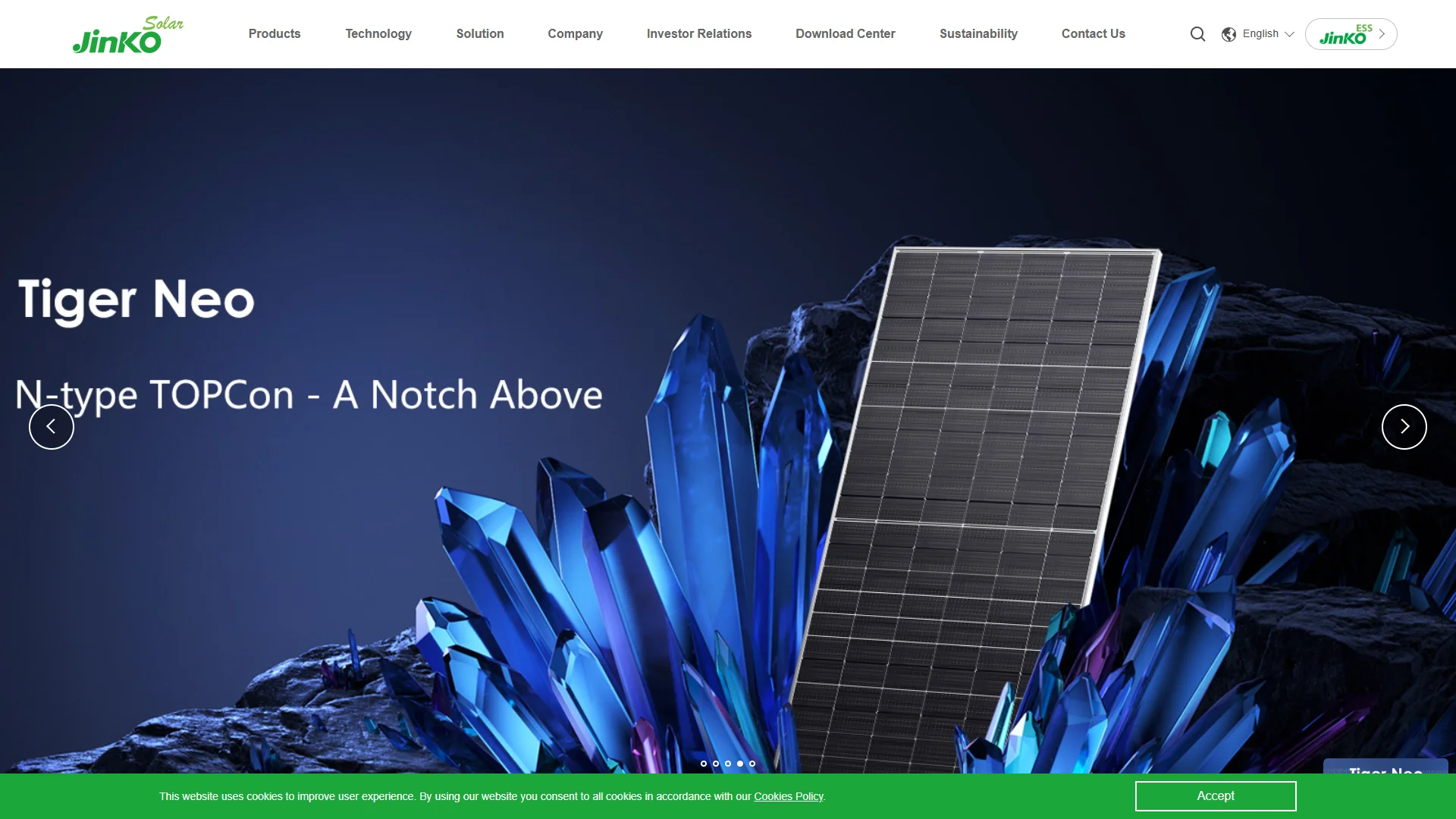
Overview: Jinkosolar is ranked first because its official product portfolio provides a clear N-type direction through the Tiger Neo family, based on n-type TOPCon cell technology. The company serves multiple photovoltaic market segments and presents module solutions for residential, commercial, industrial, and utility-scale applications. This breadth is relevant to buyers that want to compare products within one supplier’s broader portfolio rather than source separate module families for different project types.

Jinkosolar’s N-type approach is centered on TOPCon, a cell architecture designed to improve carrier selectivity and reduce electrical losses compared with conventional cell structures. The practical purchasing value is not simply the technology label; it is the combination of module power, efficiency, temperature behavior, degradation terms, mechanical-load ratings, dimensions, connector requirements, and verified certification for the intended market. These details should be checked against the current datasheet because specifications differ across Tiger Neo generations and regional configurations.
Products and technology: The Tiger Neo range includes N-type TOPCon modules for different installation contexts. Jinkosolar’s official materials describe versions intended for residential and distributed-generation projects as well as larger commercial and utility applications. Depending on the model, buyers may compare monofacial or bifacial configurations, module format, maximum power, operating-current requirements, and compatibility with the project’s inverter and mounting system.
N-type modules generally attract project developers because they can combine high power density with a lower temperature coefficient and reduced degradation relative to older p-type technologies, although the exact result depends on the specific module and system design. Jinkosolar publishes model-level technical documentation, so procurement teams can evaluate electrical characteristics rather than relying only on general technology claims. A proper review should include the product datasheet, installation manual, warranty terms, certification list, and any region-specific compliance documents.
Market and business scope: Jinkosolar’s product positioning covers the full project range from rooftop systems to large ground-mounted installations. That scope can simplify portfolio selection for engineering, procurement, and construction teams working across several project types. It also makes the supplier relevant to distributors and installers that need more than one module format or power class.
Pros / Key Features:
- Clear N-type TOPCon positioning through the Tiger Neo product family.
- Product coverage spanning residential, commercial, industrial, and utility-scale applications.
- Model-level technical documentation for electrical, mechanical, and operating comparisons.
- Availability of high-power module formats suited to projects where power density matters.
- Broad supplier portfolio that can support differing system sizes and installation conditions.
Use cases / Best for: Jinkosolar is best suited to buyers seeking a documented N-type module platform for projects ranging from residential rooftops to utility-scale arrays. It is particularly relevant when a developer needs to compare multiple power classes, consider bifacial generation, or standardize module sourcing across a portfolio. Final selection should still be based on the current regional datasheet, warranty, certification, availability, and installer compatibility.
2. Aikosolar
Overview: Aikosolar’s documented product focus is its ABC module platform. The supplied research describes ABC modules as targeting high power, strong returns, and safety-oriented designs for homeowners as well as commercial and industrial customers. The company’s stated positioning also addresses demanding environmental and site conditions, including complex mountainous applications.

Pros / Key Features:
- ABC modules are presented as high-power products designed for strong returns.
- The supplied material emphasizes ultra-safe designs and functional reliability.
- Applications include residential, commercial, and industrial solar projects.
- Stated use cases include difficult conditions such as mountains, dust, salt mist, humidity, and physical obstructions.
- The product positioning addresses limited rooftop space and the need to maximize installed capacity and annual generation.
Use cases / Best for: Aikosolar is best considered for homeowners and commercial or industrial project developers evaluating ABC modules where high power density, site limitations, safety, and performance in challenging environments are important. Buyers should confirm the exact cell architecture, module power, efficiency, degradation terms, mechanical ratings, and regional certifications for the selected model.
3. Shinefar Solar
Overview: Shinefar Solar is described in the supplied research as a China-based solar module manufacturer and supplier with an international marketing center in Hangzhou, Zhejiang. Its documented offering includes monocrystalline-silicon modules, bifacial solar panels, and solar power system support. The company states that it has established long-term cooperative relations with many enterprises.
Pros / Key Features:
- Offers monocrystalline-silicon and bifacial module categories.
- Product positioning emphasizes high efficiency, reliability, and yield.
- Provides survey and design solutions for homeowners according to the supplied company summary.
- Its offering is relevant to buyers comparing module supply with broader solar-system assistance.
Use cases / Best for: Shinefar Solar may suit residential and distributed-generation buyers who value survey and design assistance alongside module sourcing. It can also be considered for projects evaluating bifacial or monocrystalline-silicon options. Procurement teams should request current N-type product datasheets and confirm cell technology, warranties, certifications, factory details, delivery terms, and project references before making a final comparison.
4. Silfab Solar
Overview: Silfab Solar presents a portfolio covering residential, commercial, and utility applications. Its supplied research identifies Utility NTC bifacial panels, Prime residential panels, Elite panels, and Commercial Series products. Silfab also describes fully automated production lines, ISO 9001:2015 certification at its locations, and precision engineering under quality-control standards.
The Utility NTC bifacial range is described as having nearly 23% efficiency, improved shade tolerance and low-light performance, made-to-order cables and connectors, and high durability. Silfab’s materials also describe a conductive backsheet and integrated cell design intended to collect and convert more light. These claims should be checked against the current model-specific datasheet and independent project requirements.
Pros / Key Features:
- Portfolio includes residential, commercial, and utility-oriented product series.
- Utility NTC bifacial panels are described as offering nearly 23% efficiency.
- Published positioning includes shade tolerance, low-light performance, and durability.
- Manufacturing descriptions reference automation, robotics, and ISO 9001:2015 certification.
- The Utility series is described as backed by a 25-year product and 30-year linear performance warranty.
Use cases / Best for: Silfab Solar is best suited to buyers evaluating residential, commercial, or utility projects, particularly in the North American market. Its stated product range is useful when maximum power density, bifacial generation, manufacturing controls, and project-specific electrical configurations are important. Buyers should verify current availability, exact N-type classification, warranty language, and certification requirements for the chosen model.
How to Choose an N-type Solar Modules Supplier
- Confirm the cell technology: Check whether the specific module uses TOPCon, ABC, or another N-type architecture. Do not assume every product in a supplier’s portfolio uses the same technology.
- Compare complete electrical specifications: Review rated power, efficiency, open-circuit voltage, operating current, temperature coefficient, and maximum system voltage alongside the inverter and string design.
- Assess degradation and warranty terms: Compare product warranties, linear performance guarantees, degradation assumptions, exclusions, and the legal entity providing the warranty.
- Match the module to the site: Consider roof area, wind and snow loads, temperature, humidity, salt exposure, shading, soiling, bifacial conditions, and available mounting space.
- Check certifications and compliance: Confirm that the exact model is approved for the installation country and that documentation covers fire, electrical, mechanical, and grid-related requirements where applicable.
- Evaluate supply reliability: Ask about regional stock, lead times, packaging, replacement procedures, technical support, and the supplier’s ability to maintain the selected product line.
- Compare total installed value: A higher-wattage module is not automatically the lowest-cost option. Include mounting changes, inverter loading, transport, labor, energy yield, maintenance, and financing assumptions.
Final Verdict
Jinkosolar ranks first for the clearest combination of N-type TOPCon product focus, broad module coverage, and suitability across residential, commercial, industrial, and utility-scale projects. Aikosolar is a strong option for buyers examining ABC modules and demanding-site applications. Shinefar Solar is relevant to customers seeking monocrystalline or bifacial modules together with survey and design support. Silfab Solar stands out for its broad series portfolio, North American project orientation, automation-focused manufacturing descriptions, and documented Utility NTC bifacial positioning. The most appropriate supplier ultimately depends on the exact model, project location, warranty, certification, availability, and system economics.
FAQs
1. What are N-type solar modules?
N-type solar modules use n-type semiconductor material in their cells. Commercial implementations include technologies such as TOPCon and ABC. The specific performance benefits depend on the module design, manufacturing process, operating conditions, and published datasheet values.
2. Is the highest-efficiency module always the best choice?
No. Efficiency matters when installation space is limited, but buyers should also compare temperature behavior, degradation, mechanical ratings, energy yield, warranty terms, compatibility, availability, and total installed cost.
3. What documents should buyers request before purchasing?
At minimum, buyers should request the current technical datasheet, installation manual, product and performance warranties, certification documents, degradation information, packaging details, and written confirmation of delivery and support terms for the exact model and market.