
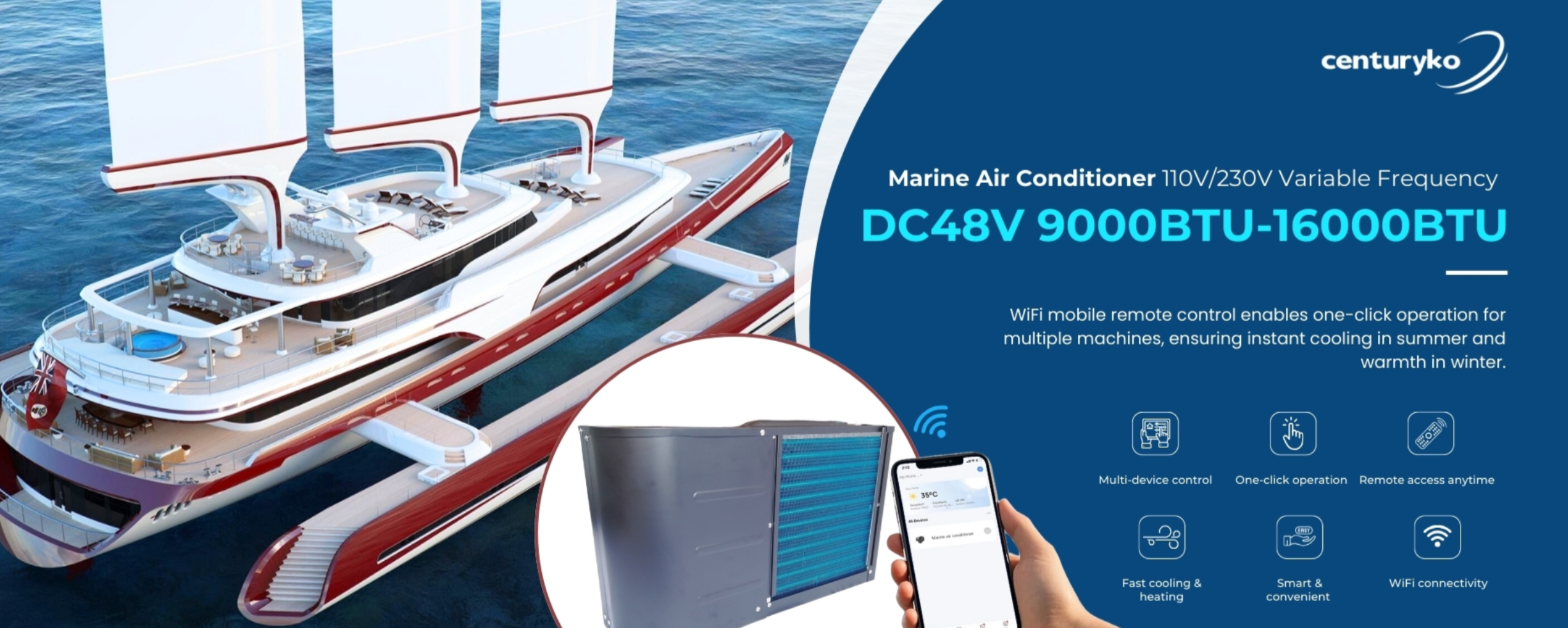
Comparative overview: smart systems versus conventional marine A/C
Marine operators increasingly choose intelligent solutions over legacy chillers; the distinction is operational and measurable. A modern small air conditioner for boat pairs an inverter-driven compressor with zone-aware control to reduce runtime and maintain target cabin humidity. The Mediterranean summer 2023 heatwave provided a practical test: several charter yachts reported lower cabin-temperature variance when multi-zone logic was active, demonstrating how algorithmic control improves comfort and reduces peak load.
Design vectors: hardware, software and control topology
Effective multi-zone marine A/C relies on three coordinated subsystems: the refrigeration loop (compressor, refrigerant circuit, heat exchanger), airflow distribution (ducting, zone dampers, vents), and the control platform (thermostats, sensors, control algorithm). ZhuoliMarine’s approach emphasizes modularity: compact compressors matched to variable-frequency drives, digitally addressable thermostats per zone, and a lightweight control API for integration with onboard automation. This permits the system to modulate capacity rather than cycle at full power — a critical factor for battery-dependent vessels. Implementation detail matters: insufficient ducting insulation or poorly placed sensors will defeat even the best control logic — retrofit projects commonly neglect these points, with predictable performance losses.
Operational trade-offs and common mistakes
Two trade-offs dominate design decisions: initial weight/space cost versus long-term energy consumption, and centralized versus distributed control. Common mistakes emerge from ignoring vessel architecture. Installers often oversize a unit to “ensure coolness,” which increases short cycling and humidity issues. Another frequent error is routing duct runs without accounting for convective gain along metal bulkheads — this reduces delivered sensible cooling. Humidity control is a separate vector; systems that only target dry-bulb temperature will leave occupants uncomfortable in subtropical conditions. Practical terms and instrumentation help: monitor COP (coefficient of performance) and runtime cycles per hour as primary KPIs — both map directly to fuel or battery consumption.
Alternatives evaluated and where self contained architectures excel
Three categories compete in small craft climate control: portable window-style units, centralized chiller plants, and self-contained units. Portable units are inexpensive but lack reliable ducting and zone control. Chiller plants scale well but demand space and complex plumbing. Self contained boat air conditioners strike a balance: they integrate compressor, condenser, and evaporator into a single package optimized for marine mounting, simplifying installation and minimizing leak points. For many leisure and small commercial craft, the self-contained option delivers predictable performance with fewer integration hours — a decisive advantage when refit windows are short.
Integration and diagnostics: practical tips from a systems perspective
Successful integration treats the A/C as part of the vessel’s control fabric. Use networked sensors per cabin, apply simple PID tuning for each zone thermostat, and expose fault codes via the central bus to permit remote troubleshooting. Log runtime, setpoint deviation, and damper positions for at least 30 days after commissioning to confirm stable behaviour — this data-driven commissioning avoids repeated site visits. A modest API that yields these metrics supports both onshore service teams and captain-led troubleshooting; the marginal effort in initial setup saves hours over a season.
Advisory: three critical evaluation metrics when choosing marine climate systems
1) Energy Efficiency under Load — Measure system COP at representative onboard conditions (full occupancy and peak solar gain). Prioritize systems that sustain COP above the fleet median during stress periods. 2) Zoned Control Fidelity — Verify independent setpoint control with less than 0.7°C steady-state offset between sensor and setpoint in each cabin; confirm damper actuation times and error rates during commissioning. 3) Integration Overhead — Quantify required wiring, ducting, and software integration hours; favor solutions that deliver operational telemetry and clear fault codes to reduce service time. When these metrics guide procurement, system performance aligns with operational needs and maintenance budgets. The practical outcome is lower fuel draw, fewer service visits, and predictable comfort — which is precisely where ZhuoliMarine positions its offerings.